Roman Naveskin
All About... Rap Music: The History of Russia’s Most Important Rap Festival
V–A–C Sreda online magazine continues its final three-month programme on significant cultural phenomena of the past that are now almost forgotten or considered extinct, but nevertheless continue to exist.
In this issue, we publish an essay by music critic Roman Naveskin on the Rap Music festival—one of the key projects of early Russian hip-hop. Established in 1994 on the ruins of late Soviet culture, the festival was an attempt by Vlad Valov (Master Sheff) to create a new cultural infrastructure. Drawing on the ideas of Mark Fisher, Naveskin examines Rap Music’s history as that of a future that never came to be: from the breakdancing of perestroika and the utopia of “popular modernism” to nostalgia and endless self-repetition.
Attempts to analyse the trajectory of Russian hip-hop through the prism of critical theory will inevitably encounter the figure of Vlad Valov and his central cultural-missionary project—the Rap Music festival, which exists to this day as a “cultural zombie”—a project that continues to function, but has long since ceased to produce new meanings. In the conceptual framework proposed by the philosopher and cultural theorist Mark Fisher, the history of the Rap Music festival appears not as the linear progress of the development of a musical genre, but as a dramatic instance of the “slow cancellation of the future,” a phenomenon symbolically expressed by the current state of the festival. “Slow cancellation of the future,” or a nostalgia for a present that is not and never will be—is used by the Italian philosopher Franko “Bifo” Berardi to describe a society in which neoliberal economics compel the individual, fundamentally insecure in the present, to seek salvation in the political past. Later, this term became a central concept in Mark Fisher’s philosophy.
What began in the middle of the 1980s as a radical and refreshing “future shock” brought about by the new political reality of perestroika and glasnost, urban neoromanticism, and the cybernetic movements of breakdancing, had, by the middle of the 2010s, transformed into a monumental structure of “formal nostalgia” in which time cycled in endless repetitions of the same aesthetic gestures.
The innovative Rap Music festival, established by Vlad Valov in 1994, became a focal point for what, in the post-Soviet context, might be termed “popular modernism”—an attempt to resolve the paradox of commitment to both a political position and consumer pleasure through an interweaving of the mass and the avant-garde. Rap Music was an attempt to create an infrastructure for culture that refused to be pure entertainment, laying claim instead to the role of a new social project. However, in time, the figure of Valov, known as Master Sheff, came to embody a fundamental contradiction: the “acid communism” he promised—the reanimation of utopia, the return of the lost future promised by the avant-gardists of the early USSR of the 1920s, to be attained through the collective practices of breakdancing—was put into practice alongside the “business ontology” of capitalist realism with its pragmatic, market realities.
This story is about lost potential, about spectres of a revolution that never came and about how hip-hop, which once promised to break reality apart, became an instrument of its legitimation.
1986. Archaeology of the cybernetic body
For Mark Fisher, “popular modernism” was a time when experimental culture was accessible to the masses through state or social institutions such as the BBC and the British music press. In the USSR of the 1980s, an analogous role was played by the Palaces of Culture and spontaneous youth associations. Breakdancing appeared in the USSR following the 1980 Olympics which, against the background of sports matches, had seen the heretofore unseen world of capitalism slip through the Iron Curtain. In 1984, the first Soviet tape-recorder appeared in the country, the “Elektronika BM-12,” as well as video cassettes with recordings of unusual dance—the films Breakin’ (1984), Breakin’ 2: Electric Boogaloo (1984), and Beat Street (1984) entered the socialist camp. Passing through local cultural mutations—from the Soviet version of afrofuturism in children’s books by Kira Bulicheva and the Strugatsky brothers to the influence of the Soviet school of mimes, the Litsedei Clown Theater, and Vyacheslav Polunin, breakdance became one of the symbols of perestroika. Vlad Valov became a part of this new movement in 1986, when breakdance was not just a selection of movements but a virus of the future, passing through the cracks of a crumbling socialist monolith.
The mechanised, electrified movement of “robots” on the “exhibition street” of Moscow’s Arbat were manifestations of the posthuman condition of a country that continued to live in the industrial past, took pride in its manufacturing, and and bore the burden of the post-war military-industrial complex as a foundational element of the state.
But Vlad Valov’s dancing “robots” on Arbat—in the original sense of the word (like the working-slaves in the Czech playwright Karel Čapek’s 1920 play R.U.R., or Rossum’s Universal Robots) became a kind of mockery of the USSR’s authoritarian bodily discipline, which had been expressed through the symbolic power of the Parade of Athletes (in that same year, in 1986, the avant-garde AVIA punk band also began to parody this aesthetic with its “From the Life of Composer Zudov” programme). The robot as the image of the ideal citizen suddenly either malfunctioned or spiralled out of control, breaking free from the confines of its biomechanical programming, as it were presaging the collapse of the entire system. This is why the scene from Karen Shakhnazarov’s film Courier (1986), featuring a brief yet striking display of breakdancing to B. T. & The City Slicker’s “Rockit” became so significant an image in the iconography of perestroika.
Breakdance as the flagship dance of perestroika—the human body under the influence of new “cultural viruses”—was “future shock” in pure form. As described by the futurologist Alvin Toffler, “future shock” is a general psychological and social disorientation that arises from “too much change in too short a period of time.” In a flash, the gatherings of breakdancers on Arbat became sites of cultural pilgrimage for the most fashionable and on-trend—an encounter with a technologised aesthetic that was unsettling precisely because it lacked an interface for connecting with the old ideology, demanding instead a complete reconstruction of subjectivity. Valov and his group Bad Balance (then still known as Ekipazh-Synchron) were important conductors of this cultural virus, which transformed the bodies of Soviet citizens into rebellious robots (or, as cyberfeminist Sadie Plant might have put it, “rewrote Big Daddy's code”) and turned the empty space of Soviet squares into laboratories for the production of new identities.
This early period is characterised by what Fisher called “white magic”—the ability of art to create new possibilities where there was once emptiness: “In the No-mu zone you dance by penetrating the limitation. Diagonals corner you, creating a new kind of tension which doesn’t resolve in the expected places.”.
Bad Balance did not just reproduce American images; they created their own version of the future, using their experience of travel to the United States, Germany, and Holland as material for their elaboration of a “Russian rhythm.” This was a period when an alternative still seemed possible, but the hegemonic ambitions of Master Sheff, the strategies of his expansion, and the colonial logic of a missionary bringing culture to a wild landscape were already laying explosives beneath the edifice of the hip-hop church—and they would detonate all too soon.
1994. The architecture of hope
The launch of the Rap Music festival in 1994 in Moscow was an act of institutional construction. It was not the first rap festival in Russia: the All-Union festival of rap music Rap-pik-91 had previously taken place at the Leningrad Palace of Youth from April 19 to 21, 1991, and the winners had been Bad Balance. Rap Music, however, was an initiative not of the system, but of a subject. In that year, having apparently accumulated energy and experience, Valov embarked on a large-scale campaign to build the logistics necessary for the delivery of this new culture to the masses, exploiting the resources of the Soviet system that had been left paralysed by its own defeat. In that same year of 1994, Vlad Valov opened the Youth Charitable Centre for Hip-Hop Culture in the motor depot of the General Staff of the Russian Ministry of Defense, where he founded a school of breakdance and djing, a rehearsal base for rap-artists, released the Rap Around You (1994) collection, printed and headed the first magazine about hip-hop culture in Russia, Hip Hop Info, and launched the aforementioned annual international festival of rap music, Rap Music.
In Fisher’s terms, this was still an attempt to create a “public service”—a zone relatively free from business imperatives, the function of which lay not in the generation of profits but the fulfilment of a social mission—the creation of “resources for the future” and the support of experimental culture. And if cassettes and periodicals were virtual objects, then the festival was a seizure of not just cultural but real territory. Valov understood that without centralised events capable of archiving and legitimising the attainments of the scene, the movement was doomed to fragmentation.
According to recollections, the first Rap Music festival was like a portal to an alternative reality. It offered a space where street experience could be converted into cultural capital without immediate subjugation to market logic. Interestingly, the first prize-winners of the 1994 festival were not traditional old-school rappers, but the alternative rapcore band I.F.K. The main victory of the 1994 festival, however, was the legitimisation of hip-hop as a form of old spectral hierarchy: as the newspaper Moskovsky Komsomolets noted, the success of the event confirmed that “rap has arrived in our country.”
In parallel, a “horizontal widening” of culture took place. Hip-hop in the 1990s was not confined to Moscow: it flourished in Donetsk, Rostov, Tashkent, Kharkiv, and other cities. It constituted a network that brought together deindustrialised zones of the post-Soviet space, creating a common symbolic cultural territory—something akin to a realisation of the concept of the “Temporary Autonomous Zone (TAZ)” proposed by the American “ontological anarchist” and poet Hakim Bey (Peter Lamborn Wilson) in his eponymous book, published only three years before the first Rap Records festival. The purpose of the TAZ, a concept that resonated deeply with cultural life in 1990s Russia, lay in creating spaces of freedom “within the cracks” of an existing system which would exist so long as the system did not notice and seek to dismantle them. These were pirate and guerilla ontologies, created to experience moments of absolute freedom in the here and now, without waiting for the end of capitalism.
A foreboding of who would emerge victorious in this existential struggle—the utopia of a “wild” culture or the city with its requirements and conventions—would long remain a leitmotif in the work of Vlad Valov and Bad Balance. It was, for example, the source of the dichotomy of their album titles City of Jungles (1999) and Stone Forest (2000). The metaphor was not, of course, discovered by Valov: “concrete jungles” are among the most persistent images in hip-hop, describing the urban environment as a severe, hostile space, in which people live according to primordial laws and only the strongest survive. This image likely first appeared in the song “Concrete Jungle” by Bob Marley and The Wailers in their album Catch a Fire (1973). For Marley, this was a metaphor for the Trenchtown ghetto in Kingston, a place, in his description, where “grass does not grow” and “the sun does not shine,” underscoring the artificiality of the environment created for the poor. Later, this image spread through the Caribbean immigrant community in the Bronx ( DJ Kool Herc, for example), until Grandmaster Flash & The Furious Five definitively cemented it into the DNA of hip-hop with their track “The Message” (1982): “It’s like a jungle sometimes, it makes me wonder how I keep from going under.”
A central artefact of Valov’s work in the mid-1990s was the composition and clip “Gorodskaya Toska.” From the point of view of hauntology—a concept borrowed by Fisher from Derrida—this track could be termed an ideal example of an “obsession with lost futures.” The melancholy and loneliness of the subject amidst the ruins of cultural and social utopia permeate the recording and lay bare the fragility of civilisation as a concept.
The visual imagery of the clip—empty streets, industrial ruins, the vices of a large city where everything is not as it seems—this is the stage set for what Fisher called the “slow cancellation of the future.” Bad Balance’s music during this period is suffused with strange urban melancholy, bitter-sweet feelings of the end of summer, which must end, but for some reason does not, and in not doing so drives you mad (like the “noon-day horror” described by Leonid Lipavsky). And this aching melancholy arises not from personal sorrow, but from the realisation that the promises of modernism (progress, social justice, technological utopia) have been nullified.
The sampling of anxious, sentimental, and otherworldly fragments from Ennio Morricone’s compositions “Giù La Testa” and “L’uomo Dell’armonica” in “Gorodskaya Toska” functions as a mechanism for conjuring cultural and civilisational spectres; the sample here is not merely a musical element but an “acoustic trace,” torn from its own time and transplanted into the space of post-Soviet timelessness. Valov very precisely captures the moment when the Soviet “tomorrow” had already disappeared but the neoliberal “today” had not yet become total. And it was precisely this context of a “liminal political landscape”—a peculiar state of being “between worlds”—that generated the unique energy that elevated early Russian rap to something greater than mere imitation of American gangsta rap. Unlike the later “realism,” this era still retained elements of the “weird” and the “eerie,” qualities which Mark Fisher regarded as the indications of a living culture.
In its ultimate, final form, this pernicious trap of nostalgia manifested itself in another hit by Bad Balance, written ten years after the formation of the group—the track “Moscow Old School” from the City of Jungles (1999) album. Back then, while the most optimistic representatives of the subculture were still anxiously awaiting the realisation of utopia, Valov and his comrades in arms were already exploring culture as a museum:
I walk down Arbat, eyes roaming side to side,
Just like ten years ago — nothing changed in sight.
There he is—that Moscow stylish old school cat,
Beating tom-toms for the crowd, bringing all the funk back.
Old graffiti fading slowly on the wall,
I remember Basket painting them back in the springtime glow.
There was a time—the time, the very start,
We took hip-hop’s gifts straight into the heart.
We bombed the system, thought we ruled the city,
Spent our dollars fast, rocked Adidas looking gritty...
Culture here has frozen in its primordial forms, while the movements of wandering bodies is in the past tense, like a sun-faded Polaroid. This text is at once a fixation of the moment when utopia imperceptibly transformed into dystopia and a hymn to nostalgia, in which joy mingles with a latent anxiety that the culture so actively championed by Valov has frozen, like an insect in a drop of mica. Like the spectre of communism that wandered across Europe, an entranced Vlad Valov wanders in his verses across Moscow as though through a personal hallucination of a past that never became the future, and in doing so sets these machines of remembrance in motion:
I walk along Arbat, still telling my tale,
Old-school Adidas on my feet, never stale.
Love keeps me warm, these stones all know my name,
’Cause we lived by the code of the brothers in the game.
[...]
Old-school hip-hop—that’s the root of it all,
The streets raised us up, breakdance gave us a port to call.
We were the first to make mixes spin on wax,
After that everybody started calling themselves DJs...
But it was precisely here, in this new cultural timelessness, on the stable foundation of a horizontal network, that, though it did not fulfill its promises, the project of “hip-hop utopia” nevertheless grew and gained strength, establishing itself as a formal hierarchy and that, instead of a Temporary Autonomous Zone, the groundwork was laid for the project of a future “market Stalinism”—a model that combined administrative control in the form of a developed bureaucracy with market mechanisms, placing an emphasis on the simulation of competition through rankings, performance metrics, and constant verifications (in the context of hip-hop, verifications of “authenticity,” that is, of adherence to a particular cultural cannon). Valov, at once organiser, judge, and participant in this process, began to form a hierarchy in which the “Master” held absolute right to interpret reality and where the work of his “employees,” much as in the late, post-utopian USSR, was directed not towards tangible results but to the creation of an appearance of success for the sake of official reports. Ultimately, it was Valov who fundamentally altered the course of Russian hip-hop, transforming it into an economic bubble capable of sustaining itself only through the constant inflation of its own metrics whilst not producing any meaning and waxing nostalgic for a time when it was all still possible.
I’m sitting on Arbat in my favorite café,
Music playing like always — everything stays the same.
Cigarette smoke dissolves around an old jazz man,
From one warm summer straight into another again.
Two minutes from McDonald’s—that streetball court remains,
We still play three-on-three, betting money on the game...
Hold up, hold up—who don’t know that Moscow old school name?..
1999. Capitalist realism
Despite the cultural stagnation recognised and reflected upon by Valov himself, 1999 was the moment of the definitive triumph of “capitalist realism” in Russian hip-hop. Cultural utopia conclusively gave way to the creation of a crisis-resistant economic model. The creation of the Bad B. Alliance by Vlad Valov and Alexander Tolmatsky signalled this shift from cultural construction to “business ontology”—or “capitalist realism,” which Mark Fisher described as a condition in which it is easier to imagine the end of the world than the end of capitalism.
Instead of serving as a portal to other worlds or fundamental knowledge regarding modes of existence, in Concrete Jungles and Stone Forests, hip-hop became a mechanism for the production of commodities. The Bad B. Alliance was structured on the model of a corporation, with each project clearly targeted to a particular segment of the market. Detsl—who took on the role of “scapegoat” in the Girardian sense—was the ideal product of adolescent consumption, as much for hip-hop neophytes for whom his music served as a convenient entry point and form of “sanctioned rebellion” (the slogan “Pepsi, Pager, MTV,” which featured in one of the most popular Detsl commercials, left no room for anything besides consumption) as for skinheads (who, within their own ideological framework, exploited Detsl as a symbol of the new generation’s degeneration). Legal Busine$$ was a product for more solid and experienced listeners, a supergroup with a cover of Tsoi’s “Pack of Cigarettes” that was daring for its time and with a name that carried an important contemporary social message, propaganda about a transition from the epoch of “bandit” capitalism to the civilised rules of the game of new Russia (symbolically, the groups debut album, Rifmomaniya, was recorded in 1999 and released in 2000). The female band White Chocolate would embody the exploitation of libidinal energies within an R&B framework, anticipating the glamour era of the 2000s, while Master Sheff himself—“the master of the broken phrase”—continued to embody the figure of the architect of the rap-empire and its “founding father,” legitimising the entire structure through reference to the history of the genre.
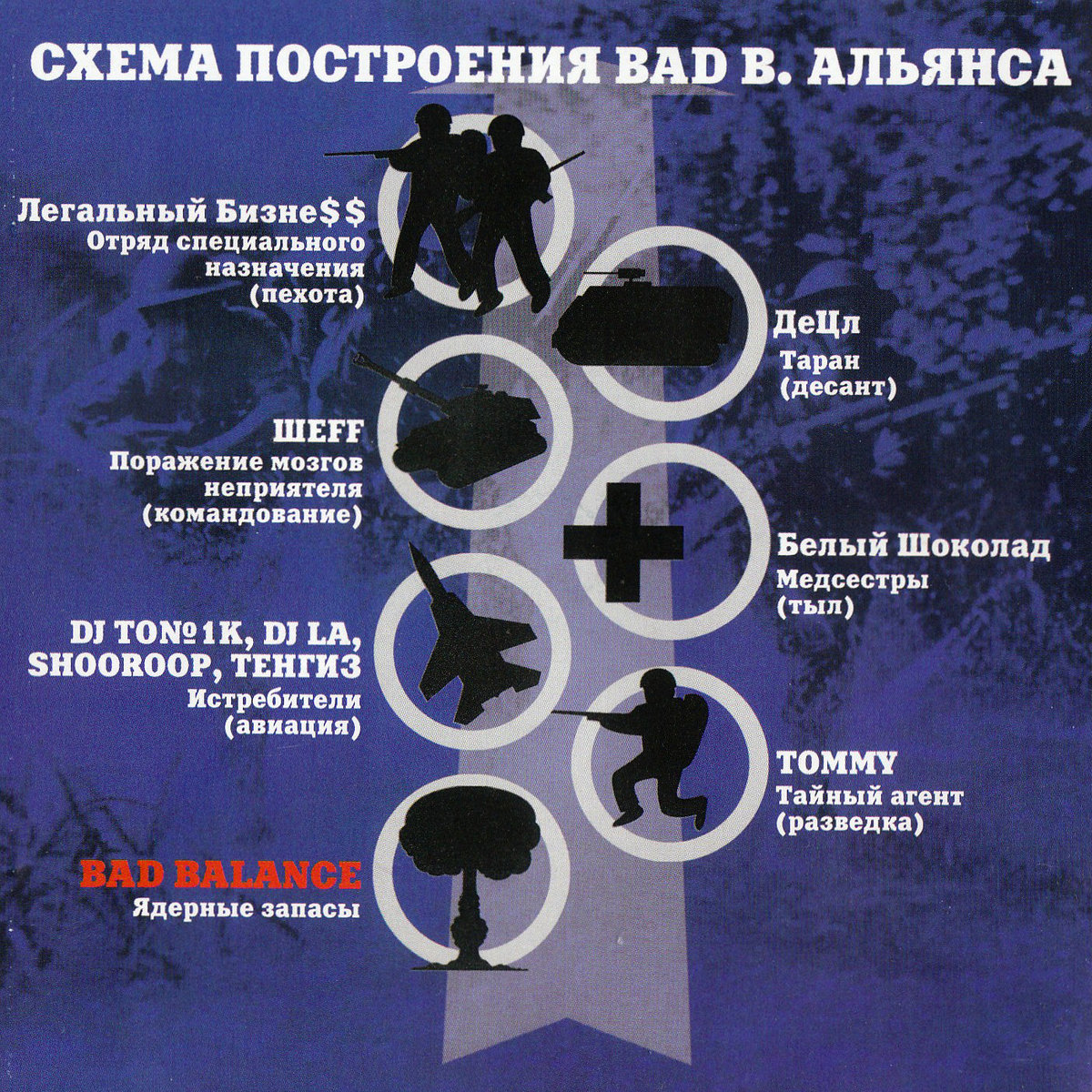
Within the Bad B. Alliance, Valov went all-in deploying strategies of “market Stalinism”—a system of rigid control predicated on performance metrics, ceaseless self-promotion, and the simulation of “authenticity.” This rigid, almost militarized structure inevitably led the project to what Mark Fisher termed “reflexive impotence.” Though the artists within the Alliance understood that they were mere cogs in a marketing machine, they felt that there were no means of conveying their message to wide audiences outside of it—the gatekeepers empowered to open a space for expression were, after all, equally capable of closing it. The only thing to be done with such a machine of control was to give it the time it needed to destroy itself. The dissolution of the Bad B. Alliance in 2001 as a result of conflict between Valov and Tolmatsky marked the collapse of this first attempt at total control over reality in Russian rap, and the sudden death of Valov’s friend and Bad Balance comrade Sergey “Mikhey” Krutikov seems to have definitively closed the doors to the forgotten cultural utopia.
The evolution of Vlad Valov’s project from the Centre for Hip-Hop Culture to the Bad B. Alliance is a striking illustration of the transition from the hierarchical structures of mass society to what the sociologists Manuel Castells and Jan van Dijk have termed the “network society.” Valov sought to construct his “hip-hop nation” as a rigid vertical system in which every artist was a node tightly bound to the central core embodied by the record label and the figure of the “Master.” However, in line with Barry Wellman’s theory of networked individualism, contemporary hip-hop entered the phase in which the individual emerges as the primary autonomous node, connected not to a particular corporation but to global media networks. If during the Alliance epoch Valov had controlled the “space of flows” through the Hip-Hop Info magazine and the Rap Music festival, the current digital reality empowers new artists to engage in mass communication independently, entirely bypassing the old intermediary institutions and destroying the cultural hegemon’s monopoly on a monolithic “reality.”
Unsurprisingly, the order of things established by Valov soon met with hostility and resistance from new horizontal structures (United Caste, for example) and passionate individualists. An episode from Pash Tekhnika’s autobiography, dating back to the very beginning of the 2000s, is telling in this regard: Tekhnika recounts a group “raid” on the “Bad B. raiders”—a symbolic “murder” of the father who had brought hip-hop to Russia.
At 16, I got a job at the club—flyering, marking (billiards games), dancer, admin, *** I left that cesspool… 'The Bat,' 'White Smoke,' 'Fantics,' 'Theirs,' 'Ours,' they raided Bad B…Sheff, just before jumping into his car and *** [taking his leave—Ed.], yelled: “Everything I do is for you!! And what do you do for me?”... and stepped on the gas…
This episode is a perfect illustration of the clash between two incompatible ontologies within Russian hip-hop of the early 2000s. Vlad Valov, in the role of “founding father,” sought to impose upon culture the rigid hierarchy of “market Stalinism,” a system in which he stood as Master, constructing infrastructure for the masses. His desperate cry just before his hasty exit—“Everything I do is for you!! And what do you do for me??” is the very quintessence of paternalistic disillusionment. Within Valov’s frame of reference, hip-hop—having ceased to be a street philosophy—had transformed into a “business ontology” exacting loyalty and discipline in return. For Pasha Tekhnika, however—who in this narrative embodies the “abject” (a concept drawn from the French theorist Julia Kristeva’s theory of horror, denoting that which is beyond the bounds of propriety—be it a stool sample in a jar, or the fetus of an unloved son, aborted after much deliberation)—this entire structure devolved into a hollow spectacle, sanctioned by capital and, therefore, fit only for ridicule and destruction.
From the perspective of hauntology, the fatal moment had come, in which “the Real,” in its rudest and most unpredictable form, carried out a raid upon the “simulacrum.” In this story, the young Pasha Technik and his entourage are the merry and malevolent ghosts of a radical alternative that never came to pass—figures who refused to serve as “soldiers” within Valov’s corporate Bad B. Alliance. In this context, the attempt to close the Bad B. Alliance was a symbolic murder of the father who confused cultural construction with despotic management and who, like Uranus, hid his own children for too long—until one of them dared to castrate him. In the end, Sheff’s final action—leaping into a car and fleeing—marks the final transition from “market Stalinism,” no longer capable of concealing its powerlessness, in a condition of “reflexive impotence”: the leader is no longer capable of leading, he can only appeal to his past achievements with wounded outrage while the future is rapidly cancelled amid the chaos of total underground.
2009. Exhumation
In 1989, Vlad Valov, the leader of the newly-founded Bad Balance and a student at the Higher Trade Union School of Culture, preserved his early demo recordings (essentially the first Soviet mixtape created using foreign beats) and buried the audio cassette in St. Petersburg. Due to a lack of funds for high-quality recording, he had taken the decision to put his work on this material on hold, for precisely twenty years. In accordance with his plan, Valov solemnly unearthed the cassette in 2008, and these archival recordings served as the basis for the band’s new studio album.
The release of Bad Balance’s album Semero odnogo ne zhdut in 2009 was as a literal hauntological gesture in the history of Russian hip-hop, an “exhumation of the lost future.” This tale of a demo cassette wrapped in ten layers of electrical tape and buried in Leningrad soil in 1989 sounds like a Gothic myth about an attempt to preserve pure modernist energy until better times. However, the realisation of this project twenty years later exposed the deep melancholy of “capitalist realism”: instead of creating something radically new, Sheff expended his resources on the technical reconstruction of the spectres of his youth.
In Mark Fisher’s terms, this gesture is a classic example of “formal nostalgia,” a state in which time loops back upon itself and “future shock” is supplanted by archival, spectral explorations (spectral in both the hauntological and audio processing sense) in the spirit of William Basinski’s Disintegration Loops or the classic recordings of The Caretaker, though with an important difference: the creator does not recognise the disintegration of memory. This was an attempt—astonishing in its sheer, undisguised vulnerability—to mend a tear in the fabric of cultural time, to cancel the intervening twenty years, and to prove that the future envisioned in 1989 remained possible. In practice, however, this album is merely a painful recording of the “slow cancellation of the future”: in twenty years of waiting, the music made no qualitative leap, and transformed from a “virus of tomorrow” into a sterile museum exhibit, forgotten and obsolete, yet guarded like a treasure by Master Sheff, locked within a capsule of myth-making and his own past. Andrey Nikitin—the editor-in-chief of the website Rap.ru at the time—offered a bleak summation of this cultural exhumation:
..not without interest on a conceptual level, the album is executed unconvincingly. Recounting tales of breakdancing and black-market hustling, listing the fashionable brands and catchphrases of those years, Master Sheff merely goes in circles: the album’s entire content could easily have been contained in a single. [...] Towards the end, Sheff entirely veers into memoir, to the extent of recounting which university he attended, which shop he worked at. Semero odnogo ne zhdut is no book of profound wisdom; it is more akin to a family photo album, carefully put together and solemnly brought out for guests, but otherwise forgotten and gathering dust in a bookcase between Agatha Christie and The Three Musketeers. Remember? The ones they had in the 1980s?
In the history of Bad Balance, 1989 was the point of maximal utopian anticipation. In the cracks of the disintegrating Soviet monolith, breakdancing and hip-hop on Arbat were a reconstitution of Soviet bodies, cybernetic prophecies promising radical deterritorialisation of mundane industrial existence. The symbolic gesture of the burial of the Semero odnogo ne zhdut cassette in Leningrad soil was an act that sought to preserve this potential, to draw out the moment, defer a culmination that would never come, to fix pure modernist energy in anticipation of a world that, as it seemed then, would belong to radically free people—creators, not bureaucrats. Back then, “future shock” had not yet been co-opted by market structures, and the “hip-hop nation” was thought of as an alternative social architecture capable of breaking reality apart through rhythm and movement. But like the project of communism, the modernist project of hip-hop proved an unattainable horizon.
2026. Slow Cancellation of the Future
Valov was one of the first colonisers of the concrete jungles on the territory of the USSR—he wanted to create a new order of things, and, in the end, when the jungle had absorbed everything, he fenced off a small area for himself and transformed it into a nature reserve—a place where former purity was preserved, though not its wild, elemental power. Just as in a nature reserve predators do not truly hunt, but rather imitate hunting while awaiting feeding, becoming living museum exhibits, so Valov in his nature reserve is no longer dangerous and does not generate new meanings, but serves simply as a reminder of the past.
Edward Said, the author of Orientalism (1978), a seminal work in postcolonial discourse, argued that the West did not simply describe the East but created an image of it that served its own interests in order to control it. Valov acted analogously with hip-hop: he adapted it, constructed a structure that set him at the top and made all other participants in the globalist myth of hip-hop elements of his hierarchy. At first, this gave Valov the stability necessary to install new values and reprogramme bodies and minds, ultimately, however, it cut him off from living processes and transformed the bodies he had liberated into a tribe of lost individuals who, as Frantz Fanon would put it, became frustrated natives in his colonial jungle, experiencing that same strange alienation experienced by the savage who seeks to imitate his coloniser to attain the right to touch the sacred shrine of his discourse.
Critical confirmation of Rap Music’s stagnation came in the form of a public appeal by long-time jury member G. Wilkes (from the Big Black Boots band) that called for a radical “reboot” of Rap Music 2025. This poignant address noted the event’s transformation into a “time capsule,” replicating a narrow layer of “Russian rap of the 2000s” while ignoring the evolution of the image, sound, and thematic substance of contemporary hip-hop. The contest winners ultimately remain trapped in a cultural vacuum—a space of zero signs, in as far as the festival has long since ceased to offer functioning social lifts or a coherent answer to the question that might be posed by a potential participant: “What will I get in return?”
This one-sided dialogue between Sheff and those around him reveals a deep crisis: the attempt to transition the festival from amateur artistic endeavour to a professional industry event. However, in the context of capitalist realism, such a reboot encounters a paradox: industry stars often ignore the project, while the structure of the festival retains participants in the illusion that “real,” authentic, standard-meeting rap has remained in the past.
Despite this vast landscape of fading signs, Master Sheff’s hyperactivity, his active existence within an alternative version of reality, a “future that has already taken place,” or “Narnia,” as the new generation of rappers ironically dubs it—conceals a deep melancholy, an inability to produce anything truly new, sharp, or capable of exerting even the slightest influence on reality. Sheff is a tragic figure, holding fast to the spectres of the past at his festival, a frozen memorial to a utopia when many believed hip-hop could change reality. And although this faith may seem naive today, a hauntological analysis allows us to see in this project not merely its failures, but its unrealised potential.
Like the persistent holding of Rap Music in empty clubs on the outskirts of Moscow, which have become something akin to a lone man’s yearly existential leap, the fact that Vlad Valov returns to Arbat every year to breakdance (the most recent video to date was posted on the 100PRO YouTube channel on April 1, 2026) is the most poignant gesture in his hauntological spectacle of nostalgia for a future that never came, his refusal to accept loss—the loss of friends, of hopes, and, above all, of utopia. The Arbat of the 1980s served as a portal through which the cybernetic “future shock” infiltrated the closed system of the USSR—by returning there year after year, inevitably losing his youth and strength in the process, Sheff seems to almost attempt to physically relaunch this “frozen time.” His aging body, executing angular, “robotic” movements with ever greater difficulty in a repressed urban landscape constrained by collective silence transforms into a living, spectral archive of “popular modernism.” In the world of capitalist realism crafted by Master Sheff himself, where hip-hop became either a commodity or a “time capsule” for the nostalgic, this dance under the spring sun remains the only form of authentic, unmonetised presence.
The dancing “Master” is a spectre of the future that did not come, one that continues to broadcast its “Russian rhythm” when all remaining nodes in the network have long since reconfigured themselves to the dictatorship of the present. This is a reminder of the fact that, somewhere deep within the foundations of his empire, the heart of that street dancer—who once believed that movements of the body could break apart reality—still beats.
The spectres of Rap Music are not just archives and forgotten names; they are the frozen project of “cultural revolution,” the very idea of culture as a “common cause,” a means of breaking apart the everyday. And so long as Valov continues to hold his festival, he—albeit unknowingly—keeps the door to this lost future ajar. A potential means of stepping through it is to transcend “capitalist realism” today: not to renounce the past, but to take its spectres seriously—those promises of freedom and innovation that once rang out on the Rap Music stage in 1994.
As Master Sheff remarked not long ago of well-known peers in the industry:
AK-47 is hip-hop. But it is a brand of hip-hop that never passed through the Rap Music festival. I am still waiting for them at the festival. Because if you want to be a part of the culture, you have to go through it.
And who knows—if suddenly, whether yielding to a momentary whim or impulse of metamodernist irony, on some cold day of December 2026, the new stars of the hip-hop scene spontaneously decide to journey to the outskirts of Moscow, where, in a cramped, empty club, in pitch darkness illuminated only sporadically by a strobe light, like Colonel Kurtz, Master Sheff awaits them in the VIP box, ready as always to conduct his annual Rap Music collective ritual, a certain utopia may be relaunched by accident, and the phantom of this future that never came, obeying this whimsical gesture, might finally come to life.
∞. Afterword
sreda@v-a-c.org
All rights reserved. Reproducing or using the materials from this web-page without written consent of the rightsholder is forbidden.